Stay updated
Recommended Posts
Our Podcasts
-
- Article
- Reading Time: 8 min read
- August 01, 2026
-
Monthly Market Outlook August 2026 By Prateek Agrawal
-
- Prateek Agrawal
https://www.youtube.com/embed/05-warI40DY
Dear Investor
A month has passed and yet thoughts seem to be much the same.
In this piece let us discuss the following:
- Higher oil prices and geopolitics keep the focus on emerging themes and potential solutions.
- Summers are elongated and hot. A cause for concern for some but probable opportunity for some
- AI could drive capex over 2026 and 2027 though at a slower pace vs 2025. Delivery of software could emerge in 2027
- The outlook for Indian equities relative to other Indian asset classes. It continues to be time for alpha
- Key Risks
Higher oil prices and geopolitics keep the focus on solutions generating new themes
After raising expectations of a resolution to the Mideast conflict, hostilities have again flared up. However, ship traffic in Hormuz continued at significantly better levels and that has kept the price of oil around USD85/bbl. Oil prices may moderate, if hostilities cede.
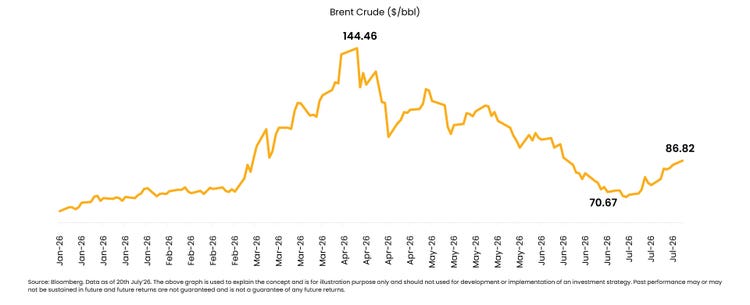
One approach to insulating a country against the oil price increase is to electrify with domestic fuel sources which includes solar, wind (and hence BESS), coal, biomass, etc. In the past period we have seen ALMM 2 getting launched on time for solar cells. There is a focus on coal bed methane projects and ethanol blended petrol. Bio blends of diesel are also emerging.
Also, with two major wars going on in the world, there are learnings that many countries are deriving from them and may continue to strengthen their defence preparedness. This could cause a round of sustained defense spend. As crude recedes, and governments feel positive about their cash flows, the defense ordering may gain momentum.
Higher crude prices drain forex. Currency has weakened. Forex stress galvanizes attention on import substitution and improving the domestic manufacturing capabilities. We have seen policy on electronic component manufacturing getting rolled out in the past period. In a similar manner, a policy on battery indigenization may also be introduced.
These steps may support growth for domestic players in the space.
Forex reserve level have drawn attention. The NRI deposit scheme The NRI deposit scheme may support foreign currency inflows, which could help address some concerns on this count.
Summers are elongated and hot. A cause for concern for some but probable opportunity for some. Inflation can help government finances.
India is the third largest power market in the world. Base power demand grew 11% YoY in June on rising temperatures, on delayed monsoons, with few days showing demand growth reaching 23% on 29th June 29 and 21% on 30th June. However, the peak demand of 265GW was lower than 270.8GW in May’26. Strong solar power additions helped meet peak demand during day time with low merchant prices.
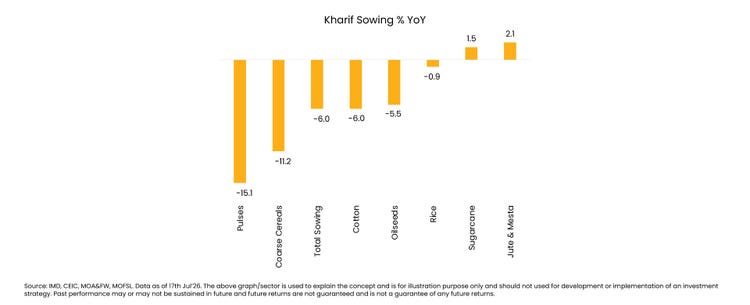
India’s 2026 Kharif sowing is trailing last year's pace by about 6%, with total acreage at 531.25 lakh hectares as of mid-July. This lag is driven by a 24% rainfall deficit and emerging El Niño conditions. To mitigate risks, the government is actively urging farmers in drought-prone areas to shift to short-duration and low-water-intensive crops like millets, maize, and green gram. While Rice has shown a lesser decline, pulses, oilseeds and cotton have witnessed a larger decline in sown acreages. If monsoons improve in the 2nd half of July, sowing trends could still improve. Lower crops may require government handholding for a section of population; however, it could imply better prices for many others.
Lower monsoons would overall deliver better GDP output on better power demand, better mining production and infra build. With better industrial activity, loan growth may also improve.
As monsoon shortfall continues to reduce, the impact may be less severe than anticipated.
AI could drive capex over 2026 and 2027 though at a slower pace vs 2025. Delivery of software could emerge in 2027
Wall Street estimates for annual hyperscaler capex track toward roughly $725 billion to $800 billion. Up to a quarter of this spending surge is driven by inflation in component prices, higher costs for memory, and massive energy/power requirements. Chipmakers, optical component manufacturers, energy grid suppliers, and data center construction firms continue to capture the vast majority of this capital.
The outlook for 2027 pivots from sheer hardware accumulation toward a broader focus on corporate profitability and operational efficiency. Aggregate capex is projected by some market estimates to surpass the $1 trillion milestone, with certain forecasts indicating predicting potential investments ranging from $1.25 trillion to $1.4 trillion. Overall nominal spending growth rates are expected to moderate to around 25% in 2027 vs 70% in 2026 based on current estimates. Because the scale of infrastructure spending is projected to drive tech giants into temporary negative free cash flows, 2027 is viewed by some market participants as an important period for AI investments to demonstrate measurable value and returns on investment.
Indian companies, particularly MNC subsidiaries may fulfill part of this data center driven demand in networking, generators, gas-based power, etc. Some domestic companies have also won some orders in spaces like transformers and generators. Indian companies are globally relevant in optic fibers and cables and electrical cables also.
Indian software companies may see increased AI work to help enterprises realize operational efficiencies from the hardware that has been purchased. The strong order book growth that Indian IT services companies may support revenues in FY28.
Indian Equities may continue to offer long-term opportunities relative other Indian asset classes. It continues to be time for alpha.
With underperformance over the past period, India Valuation has corrected and our premium to emerging market equities is at a 10-year low. Market valuations appear more aligned with historical trends. Banks and IT, two dominant spaces in the large cap indices have seen a strong correction and while we may prefer high growth spaces, these spaces should be appealing to value investors.
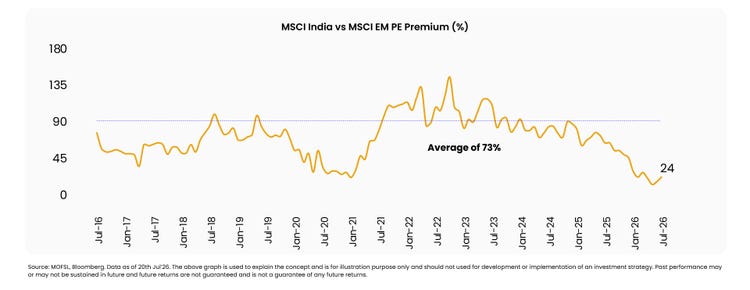
With the AI space seeing correction, India may become relatively more attractive for foreign portfolio investors. Korea outperformance over Indian indices is moderating. With our weightages in EM indices stabilizing and that may support passive flows. We have seen the intensity of selling reduce. However, the outlook for net flows remains uncertain. We do not expect positive flows yet because
- of large stock issuances in the US could absorb global liquidity and because
- the bond yields are high which could continue to support flows into US dollar-denominated assets.
The Dollar Index which was below 100 for quite some time has already crossed 100.
Lesser FPI selling may support Indian market sentiment.
A drop in oil prices to Feb levels could support the large cap indices recovering towards Feb levels with subsequent performance depending on earnings over the next period. This improves the relative outlook for equities compared with some other asset classes.
It continues to be time for alpha
We believe that markets tend to move up on account of growth in earnings and cash flows over a period of time. This implies that spaces where growth may be higher and sustains for longer have the potential to generate excess returns (alpha).
The current period is witnessing disruption and Value Migration. ICE vehicles are slowly seeing market share move to EVs. March of Online over brick and mortar continues. Consolidation in builders continue as buyers prefer big stable brands over smaller builders. Defense indigenization is gaining strength. Renewables, BESS and EVs are seeing continuous policy support which may support growth in these spaces over traditional coal and oil-based power.
Some Value Migration spaces may be losing steam. For example, for a long while, private sector banks were winning market share over PSU. This movement has now slowed. Similarly, the IT offshoring move is now in its mature phase. AI is disrupting traditional software writing while providing tailwinds to power generation and data centers.
The beneficiaries of this phase of disruption may exhibit the same combination of high growth and longevity that spaces like software and private sector banks provided in the past and may deliver favourable outcomes.
Key risks
Key risks include flare up in oil prices and large equity fund raising which may put pressure on secondary market performance.
Thank You
Happy investing
May the Good Times Continue 😊
Source: MCX India, Bloomberg, MOFSL, RBI, NSE Indices. Data as on July’26
Disclaimer:
This note/document/video has been issued based on internal data, publicly available information, and other sources believed to be reliable. The information contained herein is for general purposes only and does not constitute a complete disclosure of every material fact. These statements are based on current market conditions, which may change, and past performance is not indicative of future results.
The Stocks/Sectors mentioned herein are for explaining the concept and shall not be construed as investment advice or a recommendation. The information/data herein alone is not sufficient and shouldn’t be used for the development or implementation of an investment strategy. The views expressed above are those of the MD and CEO of the AMC and are based on current market conditions and informational purposes only.
The term ‘alpha’ is used in the context of broader market opportunities for differentiated performance through stock selection and does not indicate or guarantee outperformance by any specific mutual fund scheme.
All opinions, figures, estimates, and data included in this article are as of the date of publication. The note does not warrant the completeness or accuracy of the information and disclaims all liabilities, losses, and damages arising out of the use of this information. The statements contained herein may include statements of future expectations and other forward-looking statements that are based on our current views and assumptions and involve known and unknown risks and uncertainties that could cause actual results, performance, or events to differ materially from those expressed or implied in such statements.
This material does not compare or promote any specific investment product or strategy over others. References to investor flows or macroeconomic factors are for informational purposes only and should not be construed as market predictions or investment recommendations. Past performance may or may not be sustained in the future. Readers should exercise their own judgment and consult their financial advisors before making any investment decisions.
SEBI Registration Details: Motilal Oswal Mutual Fund – MF/063/09/04 – Mutual Fund
Mutual Fund investments are subject to market risks, read all scheme related documents carefully.