Stay updated
Recommended Posts
Our Podcasts
-
- Article
- Reading Time: 8 min read
- September 01, 2026
-
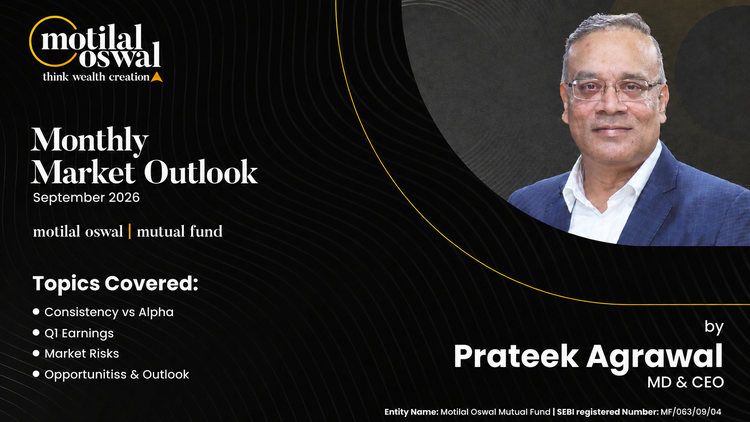
Monthly Market Outlook September 2026 By Prateek Agrawal
-
- Prateek Agrawal
https://www.youtube.com/embed/87H1Tsn2zck
Dear Investor
- This is a time when investors would have to understand the distinction between consistency and alpha
- Takeaways from Q1 result season
- Risk Factors
- Opportunities from solutions for the risks
It is time to understand what differs between consistency and alpha
Consistent returns are generally associated with performance closer to the relevant index returns, while Alpha refers to excess return over a benchmark.
We have been discussing for a long time that this is time for alpha. What we were missing out was to distinguish between consistency and alpha.
Most market participants agree that markets are influenced by growth of earnings and cashflows. If we hold this thought, then for a long time we saw large caps do very well. Up until FY20/FY21, large caps delivered better earnings growth vs small and mid-caps over most periods since start of the century. Following the thought that markets follow earnings growth, during this period, large-cap indices such as the Nifty and Sensex also delivered strong performance. Consistent performance is performance close to the indices. It is achieved with constructs close to index and being very index aware. While active ratios may be high as active ratios looks at stocks in index vs stocks in the funds, the construct could still be close. This can be achieved by having for example, stocks not in the index but belonging to same sector, eliminating an index stock in favor of higher weight in other index stocks, etc. The manager is making choices with the objective of achieving an outcome while being close to index. The outcome was consistent, as was the design. In the period till FY20/FY21, this approach this approach was focused on maintaining consistency with the index. This resulted in the quest for consistency as part of the investment approach.
Times have changed. Over the last few years, growth outside of indices has been higher than that of indices. Many factors contributed to the same. China+1 thought after Covid allowed governments to provide protection to domestic manufacturing. There was a thrust to Make in India. Many new spaces emerged. Spaces like digital, EVs, renewables, capital market participants, etc were largely absent from the market earlier. Most companies in these spaces were not born 10 years back and are now large caps. Now that growth is higher outside of large cap Indices, fund constructs away from index, in true sense, may provide greater opportunity to participate in this growth over a period of time. Since the constructs are away from the index, the returns of these funds may differ from index returns over a period of time.
This highlights the distinction between consistency and alpha. Fund constructs away from Index can have different risk characteristics. Till FY20/FY21, since growth was higher in index, the outcomes from such constructs were not satisfactory... Last few years have been different. With many high growth spaces having emerged, portfolios with significant representation to these spaces have participated in the growth of these spaces.
This highlights the relevance of Alpha. in a market characterised by disruption and the emergence of newer high growth businesses. In many ways the current period is a period when old order is giving way to the new. When this happens, it also means that investments would be sitting in businesses which had a glorious past. Money was invested in small amounts over long periods of time in spaces like software and banks. As these high growth spaces of the past, enter maturity phase, money has been moving out of these spaces. FPI holdings have declined across the board but it still is meaningful at close to 20% in large caps. In mid and small-caps, FPI holdings are not very significant and, in many cases, particularly in stocks representing themes of the current period, may be starting to move up again. As lower growth, index heavy weighted spaces see selling by FPIs, it may be a time for alpha for growth investors. Domestic investor is also playing its part. Flows have dried down in large cap MF categories.
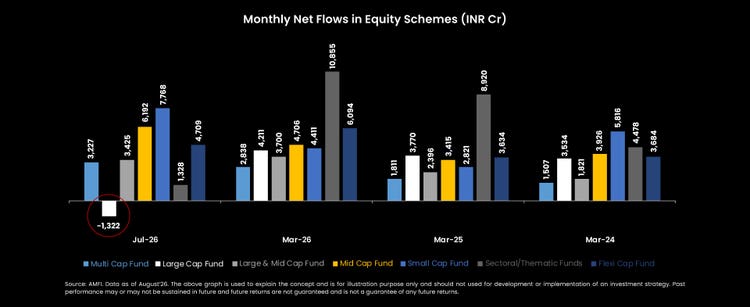
Increase in pension funds exposure to equity (close to Index construct) happened as a one-time event which took place in last quarter of last year, is also now behind us.
Flows seem to be following earnings too and may provide further tailwind to alpha.
Takeaways from Q1 result season
Q1 result season has ended. This season again earnings growth was quite strong. The key to note is that the earnings spread was good and across the board. This season was the season when the supply disruptions were expected to impact earnings. While this was witnessed in a few companies, yet the aggregates were good.
The MO Universe (ex-OMCs), sales/EBITDA/PAT grew 18%/15%/22% YoY led by BFSI (+19% YoY), Metals (+57% YoY), O&G ex-OMCs (+54% YoY), Technology (+11% YoY), and Telecom (+221% YoY). Airlines, cement and OMC dragged the aggregates.
The broad market recorded higher earnings growth than Large caps. Large caps grew 21%, Midcaps grew 23% and small caps grew 31%.
Q2 result season will be watched for the trajectory of earnings growth, factoring in the impact of delayed monsoons and other factors.
Risks at this juncture
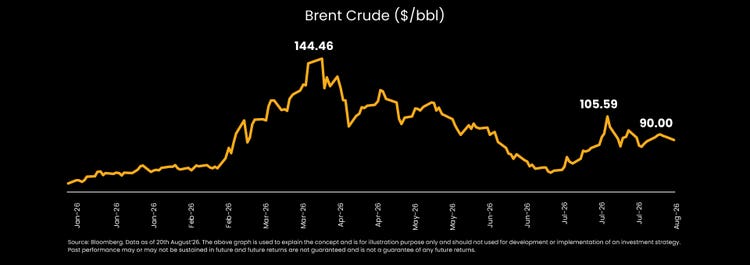
Many of the risks of the past period seem to be getting addressed. Earnings growth has returned, valuations are defendable, oil has fallen to below USD90/bbl, FPI flows are now more neutral, rains have come vs concerns on drought, trade deals are being signed with one with the US holding prospects of early conclusion. Market is still below feb 2026 levels and valuations are defendable. INR has stabilized after a large deposit raise internationally and forex reserves have crossed USD700bn.
Key risks now include the large supply of paper, though even here, some of the issuances have been withdrawn, leading to more balanced outcomes.
USD yields have been spiking up and FED has indicated that it would increase buying of long dated paper, helping yields cool off. This is a monetary expansionary move and has resulted in USD weakening and Gold moving up sharply on the announcement day. Generally speaking, this is positive for risk assets, including EM equity.
All of these have helped markets stabilize.
However, war in Mideast seems to be elongating and preventing a further fall in oil prices. Also, trade sanctions seem to be a continuous threat.
Opportunities arise out of solutions for the risk.
The only way to insulate a country against the oil price increase is to electrify with domestic fuel sources which includes solar, wind (and hence BESS), coal, biomass, etc. In the past period we have seen ALMM 2 getting launched on time for solar cells. There is a focus on coal bed methane projects and ethanol blended petrol. Bio blends of diesel are also emerging. EVs are increasingly becoming the vehicles of choice and government is also supportive.
Also, with two major wars going on in the world, there are learnings that every country is deriving from them and would prepare to defend. This could lead to increased defense spending. While capabilities matter and some of western weapons may have higher capabilities, quantities matter too. Warring nations have run out of simple things like shell. This gives low-cost vendors like India an opportunity to participate in exports. Moreover, private sector participation would increase as a country strives to develop deeper capabilities. As crude recedes, and governments are surer of their cash flows, the defense ordering may gain momentum.
Higher crude prices drain forex. Currency has weakened. Forex stress galvanizes attention on import substitution and improving the domestic manufacturing capabilities. We have seen policy on electronic component manufacturing getting rolled out in the past period. In a similar manner, a policy development relating to battery indigenization are also being watched.
Overall Outlook
We think there is a lot in the price. Uncertainties would remain but investors would learn to live with them. Domestic focused businesses and businesses with US manufacturing base may be relatively less exposed to certain. Software and realty may see developments linked to AI-related jobs and investments by AI companies seeking to generate returns on their investments. Overall, we think, equities continue to remain an asset class with potential for long-term growth, while being volatile and newer spaces continue to provide opportunities for alpha.
Thank You
Happy investing
May the Good Times Continue 😊
Source: MCX India, Bloomberg, MOFSL, RBI, NSE Indices. Data as on August’26
Disclaimer:
This note/document/video has been issued based on internal data, publicly available information, and other sources believed to be reliable. The information contained herein is for general purposes only and does not constitute a complete disclosure of every material fact. These statements are based on current market conditions, which may change, and past performance is not indicative of future results.
The Stocks/Sectors mentioned herein are for explaining the concept and shall not be construed as investment advice or a recommendation. The information/data herein alone is not sufficient and shouldn’t be used for the development or implementation of an investment strategy. The views expressed above are those of the MD and CEO of the AMC and are based on current market conditions and informational purposes only.
The term ‘alpha’ is used in the context of broader market opportunities for differentiated performance through stock selection and does not indicate or guarantee outperformance by any specific mutual fund scheme.
All opinions, figures, estimates, and data included in this article are as of the date of publication. The note does not warrant the completeness or accuracy of the information and disclaims all liabilities, losses, and damages arising out of the use of this information. The statements contained herein may include statements of future expectations and other forward-looking statements that are based on our current views and assumptions and involve known and unknown risks and uncertainties that could cause actual results, performance, or events to differ materially from those expressed or implied in such statements.
This material does not compare or promote any specific investment product or strategy over others. References to investor flows or macroeconomic factors are for informational purposes only and should not be construed as market predictions or investment recommendations. Past performance may or may not be sustained in the future. Readers should exercise their own judgment and consult their financial advisors before making any investment decisions.
SEBI Registration Details: Motilal Oswal Mutual Fund – MF/063/09/04 – Mutual Fund
Mutual Fund investments are subject to market risks, read all scheme related documents carefully.