Stay updated
Recommended Posts
Our Podcasts
-
- Podcast
- Reading Time: 8 mins read
- July 4, 2025
-
Multifactor Strategy: Investing Beyond A Single Factor
-
- Prasun Singh

Thumbnail-scaled
Traditional index strategies follow a straightforward approach, they allocate more weight to companies with larger market capitalizations. While this method provides broad market exposure at low cost, it doesn’t account for the underlying characteristics that often drive stock performance. These indices treat all stocks passively, without considering why some may show consistent trends over time.
Factor-based strategies offer a more refined approach. Instead of just selecting companies by size alone, they look at measurable traits – such as how inexpensive a stock is (value), how consistently a company performs (quality), or how strong its recent price trends are (momentum). Decades of academic and market research, including models like Fama and French, have shown that these characteristics can influence returns over time.
By focusing on such factors, investors can move beyond just market-cap exposure and build portfolios that are designed to align more with long-term return drivers. This marks a shift from traditional indexing to a more structured, evidence-based style of investing.
While many factors exist, only a few are considered robust – those supported with sound economic reasoning, academic backing, and consistency across time and markets. Research has identified a set of factors that help explain the variation in security returns across the market –
Value: Value stocks are generally associated with mature companies that have stable net incomes or are experiencing a cyclical downturn and are trading at relatively lower valuations.
Quality: Quality stocks include those companies with consistent earnings, relatively high cash flow to earnings, and low debt-to-equity ratios.
Volatility: Low volatility is generally considered by investors aiming to reduce exposure to large market fluctuations.
Momentum: Momentum attempts to capture further returns from stocks that have experienced an above-average increase in price during the prior period.
Size: A tilt toward smaller size involves buying stocks with low float-adjusted market capitalization.
What are Multifactor Strategies?
Multifactor strategies involve combining two or more factors within a single portfolio. Each factor has its own unique behaviour and tends to perform differently across market cycles. While one factor may do well in a certain environment, it could underperform in another.
Relying on a single factor can lead to periods of under performance. By blending multiple factors, multifactor funds aim to reduce this risk, smooth out returns over time, and offer a more balanced investment approach across varying market conditions.
Growth of Multifactor Funds in India
Multifactor Index funds have been steadily growing in popularity, similar to the broader rise of factor-based index investing. As of 31st March 2025, their total AUM stood at ₹5,495 crores — a sharp increase from ₹1,751 crores a year earlier, marking a more than 3x growth.
This reflects a rise in investor participation in funds offering exposure to multiple factors through a single fund. The trend is further supported by the surge in yearly inflows, which rose to ₹3,655 crores in FY2025 compared to just ₹556 crores in FY2024.
Why Multifactor over Single-Factor Investing?
In contrast to single-factor strategies, multi-factor strategies provide investors with exposure to all or a subset of the value, quality, low volatility, momentum and size factors. Gaining exposure to multiple factors can help investors achieve greater diversification and become less reliant on any one factor to drive returns.
The Nifty500 Multifactor MQVLv 50 Index (referred to as the ‘Multifactor’ Index) is developed by NSE to form a portfolio of stocks selected using a mix of four factors: momentum, quality, value, and low volatility. Each factor is given a 25% weight to calculate a combined percentile score, and the top 50 stocks from the Nifty 500 based on this score are included in the index.
Over the past 5 years, the Multifactor Index has delivered an annualized return of 27.46%. During the same period, the Value Index generated 43.80%, while the Low Volatility Index returned around 20.36%. The Quality and Momentum Indices posted gains of 24.31% and 29.55%, respectively.
The Multifactor strategy combines the characteristics of all these factors – capturing the upside of high-performing ones while balancing the downside of underperformed ones. This balanced approach may help deliver more stable and adequate returns over time.
Changing Role of Factors in Bull, Bear, and Recovery Markets
Historical Performance of Factors across Market Cycles since September 2005
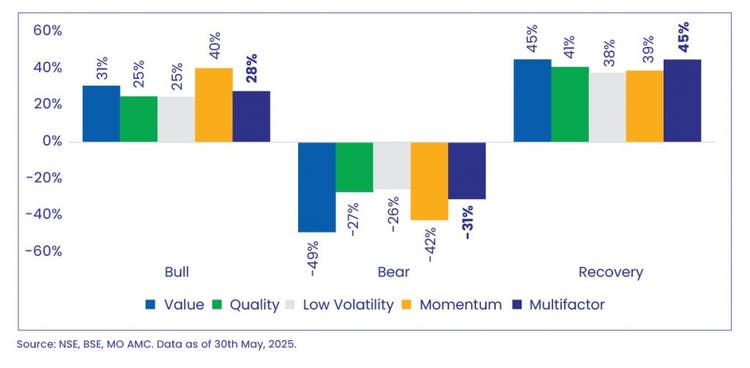
Different factor indices have shown varying performances across market cycles — with markets spending approximately 55% of the time in bull phases, 17% in bear phases, and 28% in recovery – based on data from April 2005 to April 2025. Each factor reacts differently depending on the prevailing market condition.
During bull markets, the Momentum index reflected higher returns, while others like Value, Quality, and Low Volatility show moderate gains. In bear markets, Low Volatility and Quality tend to fall less, offering better downside protection. On the other hand, Value and Momentum show deeper declines. In the recovery phase, Value has shown quicker rebounds, followed closely by Multifactor and other factor indices.
Multifactor is not built to lead in any single phase, but instead aims to show relatively balanced performance across all three – doing fairly well in bull, limiting losses in bear, and participate in recovery. This relatively balanced behaviour is due to its mix of different factors, each contributing differently across market cycles. It supports the idea that no single factor works all the time, and combining them helps reduce extreme highs and lows, offering a smoother ride through market ups and downs.
Multi-Factor approach offers Consistency
5-Year Rolling Return Analysis of Factors Since September 2010
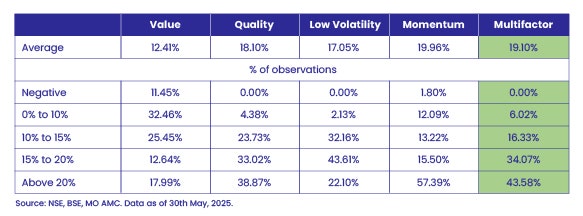
On analysing 3,586 observations for 5 year Rolling returns since September 2010, multifactor strategies have delivered an average 5 year return of 19.04%, second only to momentum at 19.89%. During this period, there has been no instance of negative 5-year returns for multifactor, indicating consistent positive outcomes over time. Around 94% of the 5-year return observations for multifactor were in double digits, and 43% of the periods recorded returns above 20%.
Value strategies had negative returns in about 11.5% of observations and recorded the average 5 year returns at 12.21%. Momentum strategy showed the return potential with 57% of observations above 20%, but also had some instances of negative returns. Quality and low volatility factors delivered stable returns with no negative 5-year periods, and a significant portion of returns in the 15–20% and above 20% range.
The multifactor strategy, by blending different styles, smooths out these highs and lows and offers a more balanced performance across time.
Excess Rolling Returns Analysis for Momentum and Multifactor
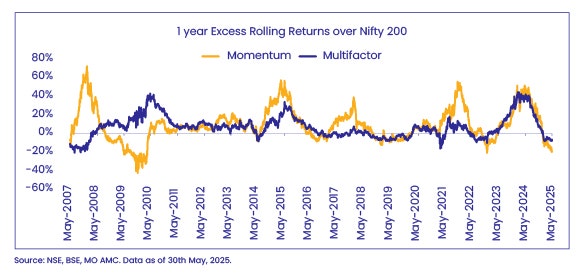
Momentum factor returns can appear compelling, often drawing investor interest due to their strong performance during market upswings. However, one aspect that is frequently overlooked is drawdown risk, the extent to which a portfolio can decline from its peak during adverse conditions.
Examining excess rolling returns over a broad-based index like the Nifty 200 provides a clearer perspective on how different strategies behave across time periods. Momentum has historically outpaced the broader market in bullish phases but tends to lag significantly in downturns. In contrast, multifactor strategies exhibit more stable return patterns, with consistent excess performance and relatively contained drawdowns across varying market environments.
This balance may help in managing volatility while maintaining return potential, especially over longer investment horizons.
Role of Multifactor in Shaping Core Allocations
In an environment where markets shift across cycles and no single investment style consistently outperforms, multifactor strategies offer a compelling approach. By thoughtfully combining complementary factors, this approach captures the strengths of each while minimizing their individual weaknesses.
Historical analysis indicates that multifactor investing has not only demonstrated consistent performance across varied market conditions but has also reduced the likelihood of extreme outcomes. For investors, this means staying invested with greater confidence, knowing that the portfolio is structured to adapt through both good and challenging times.
Rather than chasing the relevant factor each year, multifactor strategies offer a disciplined, diversified framework that aligns well with long-term goals. Whether used as a core holding or to complement existing allocations, it combines several factor-based approaches in a single, cost-efficient strategy, making it a valuable addition to a well-constructed portfolio.
Source: NSE; BSE; MOAMC Research.
The following indices are considered for each of the factors mentioned in the article:
Value Factor – BSE Enhanced Value Index Fund
Quality Factor – BSE Quality Index Fund
Low Volatility Factor – BSE Low Volatility Index Fund
Momentum Factor – Nifty 500 Momentum 50 Index Fund
Multifactor – Nifty 500 Multifactor MQVLv 50 TR Index
Disclaimer: This article has been issued on the basis of internal data, publicly available information and other sources believed to be reliable. The information contained in this document is for general purposes only and not a complete disclosure of every material fact. The Stocks mentioned herein is for explaining the concept and shall not be construed as an investment advice to any party. The information / data herein alone is not sufficient and shouldn’t be used for the development or implementation of an investment strategy. It should not be construed as investment advice to any party. All opinions, figures, estimates and data included in this article are as on date. The article does not warrant the completeness or accuracy of the information and disclaims all liabilities, losses and damages arising out of the use of this information. The statements contained herein may include statements of future expectations and other forward-looking statements that are based on our current views and assumptions and involve known and unknown risks and uncertainties that could cause actual results, performance or events to differ materially from those expressed or implied in such statements. Readers shall be fully responsible/liable for any decision taken on the basis of this article. While strong financial metrics can offer insights into a company’s performance, past performance is not indicative of future results. Investors are advised to carefully read the scheme information document before making any investment decisions. Factor-based investing involves risks specific to each factor and may lead to underperformance in certain market conditions. There can be no assurance that the objectives of the investment strategy or the factors discussed will be achieved. Investors should consult with their financial advisor before making any investment decisions. It is further important to note that past performance is not indicative of future results, and all investments carry risks.
Mutual Fund investments are subject to market risks, read all scheme related documents carefully.